Showing posts with label games. Show all posts

Saturday, November 27, 2021

Lawnmower Man 2021

During the after-Christmas sales last year I managed to gab myself a virtual reality headset. Specifically, I got the shiny new Oculus Quest 2, an entirely self contained, wire free VR headset. No need for a beefy and expensive PC to process the games. Everything is done on board the headset itself. 

There are limits to this freedom. There is a curated storefront, so I can’t simply buy games on Steam to play on the Oculus right away, though with a link cable and a built in feature, you can use the Oculus as a pass through headset and play the greatest VR game ever made to date, Half Life: Alyx. But that would require the afore mentioned beefy and expensive PC, which I do not have. 

It’s also made by bookFace, and intrinsically tied in to the Facebleag infrastructure, requiring an active Facebukk account to log in and start using. 

However, although I only ever otherwise use it for messaging my local Pokémon Go friends, I do actually have an EffBee account. So, good to go, I did a little research. 

VR is a total body experience. Most games have you standing up, moving about, looking around, ducking, dodging, and swinging arms and hands about. This is a lot more than pressing joysticks and buttons on a traditional console. I have a full body tremor, mostly centred on my arms and legs. Would I be able to get into VR at all? 

It turns out VR, and VR exercise in particular, is really great for Parkinson’s. Basically something, something, something, distraction, something, blood flow, something, something, music, fun and tah-dah! It has been shown to have overall positive mood and health benefits. 

So I got in to the VR space focusing on that. All my first apps were fitness forward, such as the phenomenal boxing simulator Thrill of the Fight, and the rhythm action games Beat Sabre and Pistol Whip, my personnel preferred gmae in that genre. I really enjoyed playing all of these, but they were exercise games, and kinda started to become a chore to turn on. Over time, with a narrow focus on just those games, I lost interest in VR entirely. 

It didn’t help that I had no one to share the experience with, both in person and online. With Covid being very much an ever present threat, I couldn’t have friends over to show of my shiny tech to and share challenges with. And I made no effort to find friends online, largely because last year the Oculus was difficult to get hold of, so very few of my friends had one. 

But now a few of my Twitter buddies have one, and I’ve broaden my library thanks to discounts throughout the year, most recently the Black Friday sales. I now have a wonderfully fun, stunning looking, very real feeling mini-golf game, Walkabout Mini Golf. I’ve been having a lot of laughs with that one, and it allows online multiplayer with avatars and in game voice chat and sounds like a whole lot of future fun, because several of my friends already own it! 

Virtual Reality is here, now. Yes, unfortunately the cheapest, easiest entry, beginner friendly, expert featured machine is owned by a very, very evil mega corporation that willfully pushed lies and mistruths and corrupted millions of users opinions on governments, elections, science, vaccines and more. Sigh. But they really are the only horse in the race at this level. 

It is a thrilling experience to put on a wireless headset and discover you can freely move about within a generated environment, interacting naturally with objects and characters. It is equally thrilling to watch a friend try it for the first time and wave at a robot friend, then pick up a can and throw it at the robot, entirely without formal tutorials. 

I’m really enjoying my time in VR. My tremor rarely causes me any issues while I’m exploring my digital world. I can’t wait to see where this goes. 

I also can’t wait for the first time Ada and Connor try it themselves. There will be video. Dear Reader, I promise you, there will be video.

Saturday, November 20, 2021

Do The Robot

After over a year and a half of not being able to play board games, this is the third Friday in a row I’ve had friends over for an evening of laughter and fun around a table. Goodness, it feels good to see friends again. 

Tonight I decided to inflict the 2005 Avalon Hill edition of RoboRally on two of my neighbours. RoboRally is a notoriously long game among my college friends, but that’s mostly down to playing “Monopoly Rules”. That is to say, no one checks the actually rules and goes with the decision of the person who owns the game, in this case, usually in relation to maps and victory flag positions. RoboRally comes with a bunch of suggestions at the back of the book for maps that cater to Beginners to Experts, Short to Long games. We played a Short Beginner suggestion, and including rules teach at the start the game was finished in a hair over two hours. That might sound long still to readers outside the modern board gaming hobby scene, but remember that a lot of the time was just us chatting between resolving turns. 

However, Claire did comment upon seeing us start “Are you sure you have enough time?

An early burst saw me reach the first flag a solid two full turns before my friends. Highlights along the way included a friend messing up an early game turn that resulted in him travelling in a big circle to end his turn in exactly the same space as he began it, and the time that I forgot that rotating right by 90° four times would put me back in my original orientation, not, as I needed, facing to my left. I failed the RoboRally Dance big time there. 

But the true highlight of the night was the final turn that saw my robot push one of my friends robots out of winning, only to immediately have my other friend reverse onto the third and final flag. In the end, all three robots were beside each other around the flag, but only one was sitting atop it as the victor. We all burst out laughing. 

A wonderful way to end any game. 


Saturday, November 13, 2021

My Friday Adventure

Last night I sat down early to write my 150 words in order to free up my evening to watch a TV show. Tonight, it’s super late as I start writing. In fact, technically, I’ve kinda missed Friday entirely. It’s already 12:10am as I write this sentence. But that’s okay, because, like last Friday, I spent the evening hanging out with friends playing board games!! 

Actually, that not entirely accurate. I spent most of the whole day hanging out with friends playing board games!! And even more time travelling about with board games as a goal. 

This morning, after dropping Ada to school, I packed my bags, kissed my wife and son good-bye and travelled far across land and water the far off shore of North Vancouver. Took me about 90 minutes by bus and SeaBus. I noted on my way that I believe this was the first time I have travelled on the SeaBus without children in at least seven years, possibly ever. Taking this rare opportunity, I sat at the back of the passenger ferry, rather than gazing out the front window. 

I met up with a friend I hadn’t seen in person since the pandemic began, and we got a lovely lunch, on his recommendation. The reason for our meeting was to swap games. I had a game he ordered, and he had one I ordered. With the swap done and nothing to rush away to, we played two board games and had a lovely chat and much laughter. 

Around 3pm we parted ways. I travelled once more on the Seabus, this time gazing out the far more enjoyable front window at Downtown Vancouver drawing ever closer.  I adventured onwards to my Friendly Local Game Store to add two more board games related items to my Bag of Holding. I chatted with the owners, but didn’t stay long! I had places to be and more games to acquire. 

I took the bus back through downtown, getting off before crossing the bridge and walked to visit a friend who had (you guessed it!) another board game for me! He took my arrival to be a good time to head out himself, and we walked and chatted together much of the way back towards the bus before separating and going our own ways, him to buy Christmas gifts (in November?!?), me to finally trek home. 

I returned to my domain around 5pm, ate dinner with my family, put the kiddos to bed, along with the nightly brushing of teeth and reading of the story books. Mud Puddle is the current hot piece of evening literature among 3 to 6 year olds. Some time around all this I managed to squeeze in an hour playing a very silly and fun drawing game with online friends on Twitch. And digital friends are real friends too.

By 8pm, I had the company of two more of my friends in my home. We talked about the news of the day, before playing two board games, neither of which I won. 

But victory was never the goal. Good company, laughter and friendship were my reward, and my day was filled with it. It is late, now just gone 12:40am. It is time for this adventurer to rest, and with a little luck, dream of board games

Tuesday, January 30, 2018

Inis

I'm not usually one for games that fall into the "dudes on a map" category of board games. I've never been good at strategy, and find it hard to see those critical moves in map games.

But Inis is based around Irish mythology, with card art by Jim FitzPatrick, an artist I grew up seeing in my text books throughout my schooling. I had to at least have a look. And thanks to a local convention, I got to try it out with a friends copy before I took the plunge myself. As it turned out, it took me about 16 hours before I owned my own copy.

I fell madly in love with Inis from the moment I played it. It is a legendary experience, full of magical moments. Win or lose, I always have a great time playing it and come away with great tales to share.

Inis is an area control game. It's a battle of wits to be in command of territories on a modular map that changes every game. You can declare your intent to become King and win once you meet one or more of the three possible victory conditions.

Inis is a drafting game. You have to react every turn to the cards you end up with in every turn from a tiny selection of possibilities. There are only 17 Action Cards in a full four player game, with four dealt to each player every turn and the last one burned, or placed to one side. Rather than keeping the hand delt to you, you pick one, and pass on the rest. You keep doing this until you have a hand of four cards. This gives you some control over the cards you have every turn.

Inis is fast, easy to learn. The rules are intuitive and allow the game to flow nicely, though your first combat takes a little work to get through. Once you see one play out, combat is a breeze as well. The strategy layer is clean and clear, and really accessible. I never felt overwhelmed by Inis, though I still love seeing the amazing moves other players manage, and learn from every game.

In my experience, Inis always results in excitement and laughter, whether you win or lose. At the end of almost every game I've played we've talked about the amazing actions or surprises that each player managed in the game while we're packing up. The final, winning move is nearly always an epic play, resulting in whoops and cheers regardless if you end as High King or defeated clan.

It's also one of the very few games I have played that genuinely work in all its player counts. Lots of games claim 2-4, or 2-5, but really only work with 3 or 4 players. Inis works with 2, 3 or 4. My 2-player game was an incredible head to head, filled with fast card play between two players that had played the game a few times. The whole game lasted a hair over an hour and felt really good.

The board and cards are beautiful to look at, evocative and full of colour. The components are fantastic, with really nicely detailed minis to represent your clans. One of the molds has a great moustache too.

Thanks to cutting back on new board games this year, I've played Inis more than any other game in my collection in the last seven years since moving to Vancouver. While at SHUX in October, I ended up teaching the game to nine different groups of people, resulting in about 30 new players, and played in four of those games.

This is easily my most treasured board game right now. I crave another game like some sort of addict. After over a dozen games played, I might even win a second time!

Related Posts:
Board Game Review Master List

Tuesday, April 18, 2017

Captain Sonar

Captain Sonar is, ideally, an 8-player realtime board game where two teams of four take command of a submarine each and try to blow the other team out of the water. The four crew of each submarine are:

The Captain, who calls out directional orders for her boat and watches in dispair as her and her crew spiral into an inescapable, crushing darkness.

The Radio Operator, who listens to the increasingly uncertain commands of the enemy captain and attempts to discover the location of the opposing vessel, mostly through a haze of frustrated head-scratching and sudden clarity, akin to solving a 1,000 piece jigsaw puzzle.

The First Mate, who is tasked with making ready the various systems on the submersible, and then politely informing the captain she can't use them because everything is broken and/or on fire.

The Engineer, who breaks things constantly, much like some sort of traitorous gremlin.

By working as a team, or at least a horribly faded facsimile of one, you hope to inflict four points of damage to the enemy first, crushing them within their steel sarcophagus under tonnes of seawater.

Played in realtime with a full player count, Captain Sonar, by Matagot, runs at about 30 minutes, the first 25 of which see both teams travelling the frigid depths, oblivious to their opponents true location, before ending in a burst of adrenaline and excitement as everything suddenly clicks into place on both sides of the table. It is crazy, chaotic, frustrating and utterly, absolutely, insanely genius.

The first time I played Captain Sonar was with six players, one of whom was probably too young for the game. This resulted in a 3 versus 2.5[1] player game. It ran longer than hoped, mostly because I was teaching and learning how best to teach it along the way. The second and third had eight players, but also ran well over 30 minutes each, for a few reasons, none of which were the games fault[2].

Games four through nine however were much more how I imagined the game would play from reviews I had seen. Games four, five and six were all fast, frantic and unbelievably hilarious, with everyone howling with laugher whether they were on the winning boat or not. This, despite those games being played in a noisy convention hall among 200-odd other gamers. Games seven, eight and nine were equally fast, in a room with just the eight players present, but ended with some tension, not due to the game, but to the mix of personalities present.

Captain Sonar is a fun party game and should absolutely be treated like that. Don't over-think actions, or get annoyed when someone on the other team makes a mistake. Laugh and congratulate your opponents, win or lose, and then challenge them to a rematch. Don't worry if you're feeling lost in your first game at the start. You're supposed to feel like that. Trust me, the other team feels the same way.

If there is a fatal flaw to Captain Sonar it is the player count. Dispite the box proclaiming it to be for 2-8 players, you really do need eight players to have the most fun[3], which is fine as long as you treat it like a party game, only played when you have lots of people around. And play it in realtime. There is a turn-based varient, but use that to run through a few sample rounds before pushing into realtime as soon as possible.

The artwork is beautiful where there is artwork, the roles are hilarious, the player interaction is chaotic and the game has become a huge favourite in my collection, after a short rocky start almost beached it. I've only owned it since Christmas, and with nine games played already, I don't have any other game that I've played that much in that short a time since, probably BattleStar Galactica The Board Game was released. And if that isn't a huge endosement, I don't know what is!!

Amazing YouTube board game review (mostly) channel No Time For Games has a wonderful short on Captain Sonar. Watch it below, then go and watch everything he's made (there's not that many and they're all short[4]) and then subscribe, because this guy deserves more fans.

[1] Maybe even 3vrs2, because one of the players on that team was splitting his time between his own station and watching and correcting her station, diminishing his role effectiveness in the process too.
[2] Missed rules and language barriers mostly, though also hard-core gamers over thinking things a bit.
[3] I weep at the thought of playing it as a 2-player game.
[4] I highly recommend his Inis video.

Related Posts:

Board Game Review Master List


Monday, April 17, 2017

Pack It Up

I put together a video of me packing my shiny new Game Canopy with some of my favourite games! The orginal version had a piano cover of a licensed track, but this one has license-free music thanks to BenSound.com.

Related Posts:
The Game Canopy
ChromaCast Cajon Bag
Battle Of The Board Game Bags

Sunday, April 16, 2017

ChromaCast Cajon Bag

I've always wanted a good carry solution for my board games when I bring them to friends game nights or meet ups,m which is why I backed the Game Canopy on Kickstarter. But as with any Kickstarter, I had a long wait ahead of me, and several events before then.

I started to hear about alternatives to expensive custom carry cases on the BoardGameGeek forums, and one in particular was mentioned again and again.

Cajons are cuboid shaped drums played usually by sitting on it and slapping the face with your hands. But the important thing about them is that the carry cases are them also cuboid, with some padding, and, roughly speaking, about the same base dimensions as a board game box. According to the folks at the BGG forums, ChromaCast made a good one that was fit for purpose, and only cost around $25.

At that price, it was worth the risk.

My ChromaCast cajon bag can hold six to seven board game boxes stacked one on top of the other, as long as we're not talking the oversized ones. Even then, there's a little breathing room on the sides for a hardback RPG book or small card games. It has light paddding all around, and a big, chunky plastic zip running down each side that opens the entire front panel, giving easy access to remove any of the games within, which is very nice. It also has a flap on the front top that covers the gap at the top where therre isn't any zipper, protecting the contents from the rain.

The fabric is apparently water resistant, though I doubt it's to any great degree, but it's a fair sight beter than an Ikea bag would do, or, apparently, my backpack, which has failed me once too often. The interior fabric is rough and I wouldn't want to have my games sliding around in it too much, as I could easily see it rubbing off corners and edges. That's why when I've used it to date I've packed it on the sides with either some light cloths or one or two play mats.

The stitching around the outside isn't designed to stand up to the weight of a full load of games either. The top handle is only stitched to the upper seams, and the shoulder straps, while slightly better, are still very lightweight. I used my bag to carry games to a few meet ups and Terminal City Tabletop Convention, and it's already ripping at the top.

One solution I've been using is not over filling the bag. Instead of packing the seven games it could hold, I only pack four, filling the rest of the space with a large felt I can use on the table we're playing at, as well as some small, light card games. Even then, I'd only carry lighter boxes in it, so no Cosmic Encounter. Another option is to invest in one of those small shopping trollys you often see the elderly employ. Attach the bag to that and wheel it around, rather than carrying it.

It's clear that others have been using this bag and enjoying it for board game travels. The Amazon reviews are all 4 or 5-stars, with hilarious comments like "Cajon owners beware, the board gamers have found your Cajon bags, and we love them", and "I bought this for my husband who is a HUGE gamer".

Mainly because of it's price, I'm hesitant to dismiss the cajon bag as a possibility if you're looking for something to carry your games in. As long as you're aware of the caveats and willing to be careful with it, you really can't go wrong for $25. It is functional, it will somewhat protect your games, and it does turn heads when you unzip the front panel and reveal a broad selection of games instantly accessible for play.

Related Posts:
The Game Canopy
Board Game Review Master List
Battle Of The Board Game Bags, comparing the Canopy to the ChromaCast

Saturday, April 15, 2017

The Game Canopy

I don't drink, smoke or do drugs, nor have I in recent years been spending money on addictions I used to have, like comics, action figures or video games. These days, and for some time now, board games have been my one vice, the one thing I impulsively spend money on, either in my friendly local gaming stores or online, especially at Kickstarter.

I'm proud of my collection, and enjoy sharing it with others, both long time friends and new. But carrying games safely has been an issue for gamers like me for years. We use Ikea bags, backpacks or, in a pinch, light plastic shopping bags, risking rain and crush damage, or the corners getting rubbed away on rough surfaces, all of which have happened to games I own at least once. In fact, just last month I brought Captain Sonar to a friends place, safely tucked into my backpack, only to arrive at gaming and have to wipe off the rain that got though the fabric.

I do live in Vancouver after all. It's a temperate rainforest. It rains.

A lot.

Which is why, despite the perceived high cost, more-so after including shipping and taxes, I was willing to back the Game Canopy from Level 3B when it appeared on Kickstarter back on April 24th, 2016, almost a year ago now. I was there when the campaign went live and one of the first backers, number 191 out of a final total of 1,753. This isn't even my first time talking about the Game Canopy on my blog.

After what felt like much longer than a year of waiting, I have my new game transport system in my hand. A year of waiting, anticipating, reading updates, following progress, getting increasingly more excited about how good it could be. That's Kickstarter's biggest flaw. No matter how good the final product is, it's almost impossible to live up to the imaginary possibilities that lengthy waiting conjures up.

Except, the Game Canopy is that good.

Padded on all sides, including base and top, the Game Canopy is custom built to protect your games in best possible way. Level 3B thought of everything. There is even padding inside to cover the zip so that it can't rub against its precious cargo. The top carry handles are stitched all the way around the bag to prevent the load from pulling on one seam, with D-rings on all corners front and back giving you plenty of options for how you'd like to attach the shoulder strap, which itself is the nicest shoulder strap I own, thick padded with a grippy material underneath.

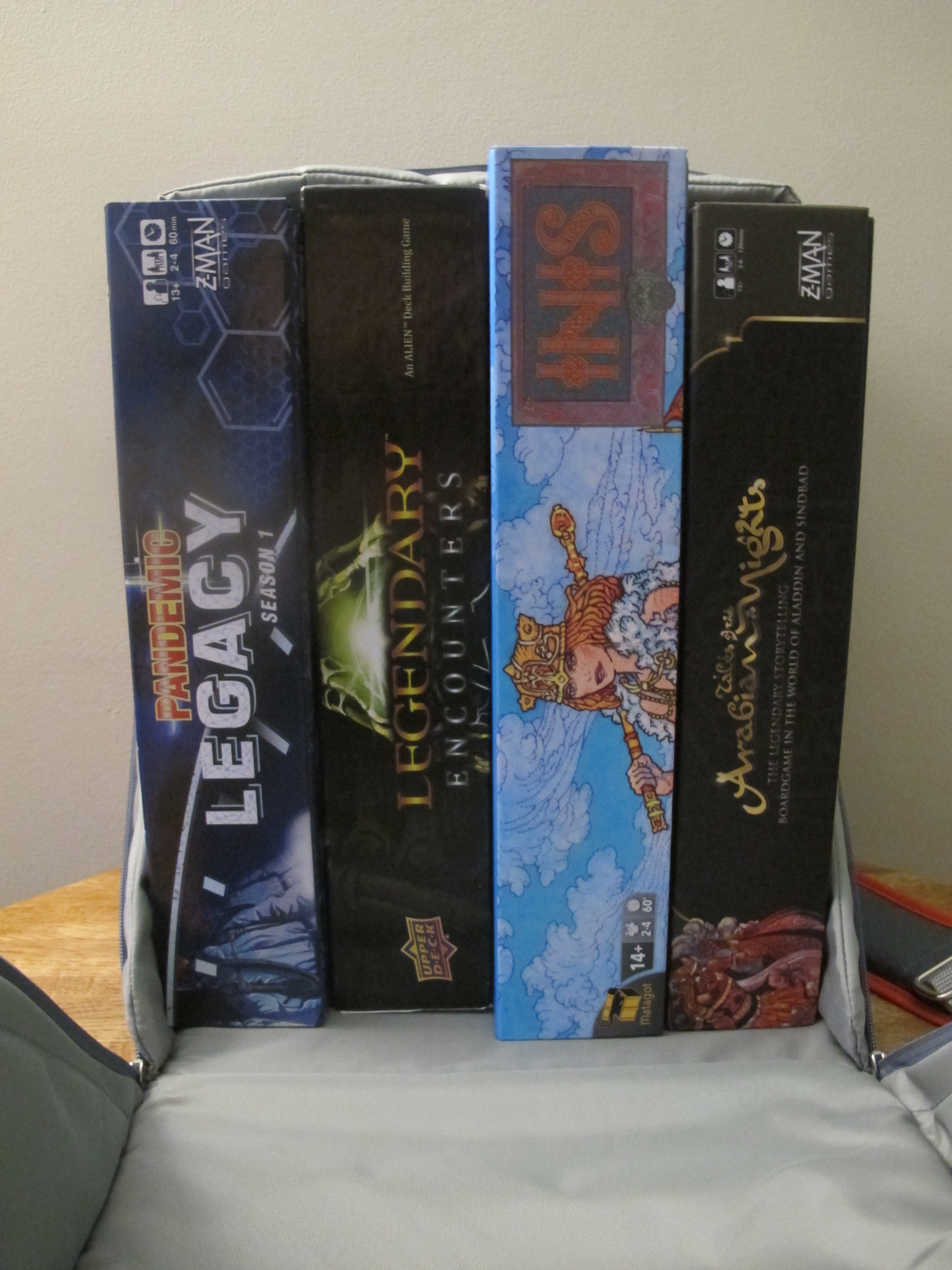
The Game Canopy can comfortably fit five "standard" sized board game boxes laying flat, one on top the other. You know, the Ticket to Ride, Mysterium, Cosmic Encounter square box. Of course how many you can fit and how many you can carry can be vastly different numbers. My Cosmic Encounter box includes all the expansions to date and is a hefty load by itself. Change the orientation a bit and the Game Canopy is tall enough to handle Inis, Tales of the Arabian Nights, Pandemic Legacy Season 1 and Legendary Encounters. Side by side. Together. Not that I'd advise carrying those four games together. I have no doubt the Canopy could handle it. I just doubt you or I could. That's a lot of compressed dead tree matter.

And it looks great doing all this. I chose the charcoal base with mandarin trim (read: grey with orange edges), and it's exactly as the promotional photographs indicated. My own photography doesn't do it justice in the visual appeal. I love how clean, crisp and professional it looks, while also being fun and bright. Board gaming isn't just a hobby for recluse stereotypical nerds, and the Game Canopy is easily a carry bag I'm going to be proud to carry around the city to events and display. It's just so gorgeous!

All in all, the Game Canopy is everything I could have hoped for. I'm really excited to take it out to my next game night at the end of the month. I can tell this is the start of a beautiful relationship. Just me and my Game Canopy and Captain Sonar and Mysterium and Takenoko and Santorini and Battlestar Galactica and...

Addendum: While writing this and testing out some game combinations for the photographs I learned my two year old can open and close the zip, and really enjoys playing with my Canopy. A great start for my future gamer.

Related:
ChromaCast Cajon Bag
Board Game Review Master List
Battle Of The Board Game Bags, comparing the Canopy to the ChromaCast

Terminal Gaming

In a previous post I talked about my favourite weekend of the year, Terminal City Tabletop Convention. I discussed why I love it, mentioning that I get to play lots of games. Now I want to go into detail about the particular games I played.

This year I hit the ground running, jumping into a game of Inis as soon as I walked in the door. Inis (pronounced "Inish") is an Irish mythology themed area control game that I've been interested in since I first heard about it. Thanks to new friend Marc (phone contact Marc TCTC) I got to learn and play it, and then went home and ordered it online. It was really quick to learn, and has a wonderfully clean ruleset, with only combat causing us some initial head-scratching, but once we had a fight or two, we totally understood it. The components are nice, with the armies having a handful of different models for their units, adding nice variety to the board. The art on the cards and tiles is gorgeous, all done by aclaimed Irish artist Jim Fitzpatrick.

After Inis, I taught three other players Quantum, the dice-as-spaceships strategy game, which I love, and they seemed to enjoy as well. I'm pretty terrible at Quantum, and usually I'm on the receiving end of another players epic final turn, where all their upgrades fall into place for some bonkers cool victory. But this time, I managed to pull off just that, dishing out a dramatic turn to drop my final colony onto a planet and secure galactic dominance.

One of the highlights of the weekend for me was getting to play four games of submarine themed team game, Captain Sonar, each with a full player count of eight. Well, technically, I played two games and "GMed" the other two, answering questions as they arose. The first one was on Saturday and went a bit longer than hoped, and I was upset that maybe the game wasn't as much fun as advertised. But the three games on Sunday were amazing! Each lasted under thirty minutes, and we're jammed with hilarity and tension! They were exactly how I hoped the game would feel, and now that I've played it properly, I feel I know better how to teach it in the future, and what elements beyond the rules to draw attention to. I'll do a full review of Captain Sonar soon, but the games I played at TCTC definitely taught me a lot about the game.

Super Motherload was being taught throughout the weekend, and I jumped into a game on Sunday, falling in love with it immediately and grabbing the last copy on sale as soon as I was done.

I played many more games over the weekend, but these were just some of the highlights. Terminal City is a great convention every year, but my bank account always suffers during and after.

Not that I'm complaining.


How To Make Friends And Crush Your Opponents

When we first arrived in Canada, tabletop gaming was integral in how we made friends. It was through RPG.net that we met the lovely couple who took us in that first week, and showed us around this strange new city. Once we got our own place, the first thing I did was Google local game stores and went directly there, where I met many of the friends I still have today. And I still use tabletop gaming as an ice-breaker for making new friends.

So when I discovered a new tabletop gaming convention was having its first event back in 2014, I knew I had to be there. And I've been going every year since.

Terminal City Tabletop Convention, or TCTC, is a weekend long tabletop celebration started by one man, and has been my favourite annual event of the year four years running. This years TCTC was March 4th and 5th, and I'm already looking forward to next years. Every year I anxiously await the chance to playing with friends I only get to see at the con, as well as making more new friends every year. My phone contacts list is filled with "John TCTC", "Michelle TCTC", and so on, and my group email gaming list grows every March.

TCTC is a great opportunity to play old favourites with new opponents, try brand new releases, classics that you missed, or just something different. Better yet, there has been strong support since the very first year for independant local developers to show off their in-development creations and get feedback on them. Prototype Alley is always a busy corner of the convention floor, and this year, there was even a new award and prize for the most promising prototype submitted, backed by support from Panda Game Manufacturing. I played a bunch of stuff all weekend, and taught a whole bunch more, but I'll leave those details for another post.

One of the more popular areas of TCTC on the Saturday is the silent auction, which started in 2015 with just a few small tables on the stage area, grew last year to fill every inch of space available on the tables, to this year where the stage quickly burst its banks and flooded onto several overflow tables off to one side. The auction gives attendees the chance to bring along and sell games they no longer play, and pick up games they might be interested in second-hand. I've sold something at every auction to date, and usually buy sometihng as well, but this year I was way too busy playing games to bother with the stress of trying to outbid others that I just didn't bother.

I love teaching games. I bring a few bags filled with games I'd like to play or teach, and I do end up spending a lot of time sharing out my collection and teaching others to play while I play something else, or even go teach another game and drift between both as the group play their first few turns. TCTC has a Game Steward system to help attendees pick out and learn new game. Seeing as how I love teaching anyway, it made sense to sign up and help out. I ended up teaching probably over half a dozen games, including Castles of Mad King Ludwig, Tsuro, Onitama, Tak, Patchwork, Santorini, and four different games of Captain Sonar!

One thing that struck me as odd was the number of requests for two-players games. I forget that although I'm there to play with as many people as possible, some folks are there to find new games to play with their partner. It made me wish I'd brought my copy of Quoridor along.

If I had one complaint it was that it had become too popular for its current venue. I'm delighted to see it grow and grow, because that means more people for me to become friends with, but it's outgrowwn it's current space. In previous years, numbers have been limited to comfortable levels and I felt that everyone had a table to be at all weekend. This year, Saturday especially, there were plenty of folks wandering the hall looking for a corner of a table to set up and game on. People seemed to be on top of each other, careful not to knock into the gmae beside you with your elbow while you played your game. At one point, we had to move out to the hallway and use two tables in the public access area. Thankfully, while I was writing this post, it has been annouced that TCTC 2018 will take place in a much larger venue! Woot!

Year after year Terminal City Tabletop Convention has been a great experience, meeting and making friends, playing a bunch of games and having a great time. It's the kind of thing I wish we had more often in Vancouver, but it's extra special because it's only once a year.

Roll on 2018!

Related Posts:
Terminal Gaming


Sunday, November 22, 2015

Codenames

Sometimes big fun comes in small packages.

Vlaada Chvátil is the designer of space junk builder and racer Galaxy Trucker and space ship crew simulator Space Alert, but is most famous for the magical stategy game Mage Knight. So you'd be forgiven for thinking that his expertise lies solely in big box, big rules games. But everyone needs a change of pace, and Codenames is Vlaada's.

When you open the box you'll be surprised to find just a few packets of cards, in two varieties, and a sheet of thicker card stock with a few cards to punch out. It becomes immediately obvious that this game is clean, clear and simple, but by no means basic.

Codenames plays ridiculously cleanly. You set out 25 cards in a 5x5 grid. Each card has a single word printed on it twice, back to back, readable from both sides of a table. Then there's the map card, a square card with a 5x5 grid of squares, eight coloured red, eight blue, one black and seven cream. Eight plus eight, plus one plus seven equals 24. The last of the 25 squares will either be red or blue, deciding which team starts first, having one extra word to identify.

Players are divided into two teams, each made up of one Spymaster and one or more Field Operatives. The two opposing Spymasters sit on one side of the table, with their Field Operatives on the opposite sides. The Spymasters can see the map, or key, and are trying to clue the Field Operatives in to which cards are in their teams colour.

But it's not as easy as giving coordinates to the colours you want. Spymasters are restricted to only saying one descriptive word and one number. With that, they have to find connections between the words in the grid of 25 on the table, using the key to tell them which cards are important to them. So if the words Day and Star are in your colour, you might say Night, 2, in the hopes that your team get the connection.

And that's really the essence of the game. There are rules about guessing, such as not using part of a code word, like if Seahorse is on the table, you can't use Horse, or Sea as the clue, and there are rules for passing the turn to the other team, but all that is in the silm rulebook. Spymasters give clues, their teammates try to decipher those hints and find the required cards, and everyone wants to avoid that one black card which acts as an assassin, instantly losing you the game if chosen.

Codenames is fast. You can get a game set up in less than a minute and played in less than five if your team is on fire, less than ten if they're struggling for inspiration. And the second game will be even easier, as all the word cards are double sided, so for a second game, simply flip the grid!

I highly recommend Codenames. It's fast, easy to teach, and endless fun. The grid of words will never be the same, so there's no chance you'll just learn an optimal codeword and over use it. As long as a player can read all the words, they can play the game, so it works really well with younger players too.

There is a free app available for iOS and Android that generates the key and looks pretty. This means that it's possible to try the game using the app and a deck of Apples to Apples words, as long as you do some curation on the cards that come up. A fun way to try out this fantastic board game, but not a good long-term substitute.

Photos and formatting to be added later. I'm running disasterously behind on my posts.

Wednesday, November 18, 2015

Keep Talking And Nobody Explodes

"Right. I'm in a dark room. There's a clock reading 18:43, and a timer reading five minutes."

"Ignore the clock. That's the actual time. What's on the-"

"Cool! It uses the PC clock to have the real time in the game? Cool. That's-"

"We don't have time for this! What's on the bomb?"

"The timer reads 4:46. There's a space with wires, a button marked "Hold" and a thing with four buttons with weird symbols on them."

"Right, how many wires?"

"Er... Six vertical wires. Red, red, yellow, bl-"

"Horizontal."

"What?"

"They're horizontal. Vertical goes up and- we don't have time for this. Go on."

Later.

"The bar is white."

"Okay. Release the button when there's a 1 in any position on the countdown timer."

*BZZZZZZZT*

"I said 1!"

"I know! I did that. Wait. This time it's blue."

"Release on a 4."

*BZZZZZZZZT*

"WHAT ARE YOU DOING?!? I... Oh. Oh. You said a red button marked Hold... Just tap the button. Don't hold it at all."

"Okay. Done."

"Yeah... my bad."

"Last panel. Four buttons. Top left is a backwards C with a dot in the middle, beside that is a kind of balloon thing, below the C is a mountain with a road on it, and then Ha-"

"Wait. Stop. I've only gotten the C one so far. I have no idea what else you're talking about. What's the balloon?"

"It's like a circle on a pole. A quidditch goal."

"Oh. Got it. Next."

"The mountain... er... it looks like... um..."

"Does it look like an A and a T stuck together?"

"Yes! That's it!"

"Okay. And the last one?"

"HalfLife 3 confirmed."

"Got it. Balloon, mountain, HalfLife 3, C."

"Done!! We did it. 43 seconds left on the clock! Easy peesy. Lets do the next one."

And everyone died because no one could read Morse Code.

The story you just read is mostly true, although it's various beats occured over a few seperate games, with a variety of clueless bomb disposal teams, rather than one entirely incompetent one.

Keep Talking and Nobody Explodes has been the cause of the most laughing I've done while playing a game with my friends in months, if not years. It's simply a laugh a minute, chaos simulator that will often end with the bomb exploding, but will always end with smiles.

One player can see the bomb and has to describe the various components to the other player or players, who can't see the bomb, but who have the manual and can talk the first player through disarming each component.

Keep Talking is so simple and fun that anyone can play with a minimum of explaination. In fact, I've had great fun just handing someone the controller, explaining the four controls (Left stick to move between highlighted components, right stick to rotate, A to select, B to cancel) and letting them go with little to no further instruction. It's fun listening to them come up with their own way of describing the various elements, especially if you get what their talking about but can resist the urge to suggest your own "better" desciption.

Keep Talking and Nobody Explodes is available on Steam and developed by Steel Crate Games, a Canadian indy developer, and I just cannot recommend it highly enough. It's for two to as many people as you can fit in a room, and is hilarious from opening tutorial to the final explosion and beyond.


Monday, November 16, 2015

Join Me On The Couch

Some of my best childhood memories are playing video games with friends and family, all sitting in the same room, within shouting, and hitting, distance. From the time my cousin yanked the SNES controller clean out of the console rounding a corner in Mario Kart, to the time my brother and I stayed up past midnight with two Garda recruits playing four-player GoldenEye deathmatch on the N64 with proximity mines, knowing the recruits had an exam the next morning[1].

But, for a while, the concept of couch multiplay was replaced almost entirely with on-line access, gaming against annoymous users half a world away. Games stopped offering split-screen competitive modes, and sometimes even split-screen co-operative modes.

Thankfully, the couch is coming back into fashion.

I first played SpeedRunners at PAX Prime 2013, and bought it that evening from my hotel room. It a fantastically frantic game of heroes racing around a circular course, jumping, sliding and dodging obstacles along the way. As players fall behind the group, they get eliminated, and the screen slowly shrinks down to just a tiny box with everyone laughing riotously at the chaos.

SpeedRunners is the perfect couch multiplayer game, as eliminated players start to pick alligences among the remaining runners, but rounds are over fast, so the player you were cheering for one minute might become your closest rival the next.

I've had many great hours filled with laughter playing this game. With races generally over pretty quick too, more than four players can enjoy the experience, taking turns on the controls. A real party favourite.

If you're looking for a longer experience, Artemis: Spaceship Bridge Simulator is an amazing co-operative game where up to six players can work together as the crew of a starship in hostile space. Each player takes on the role of a member of the bridge crew, either Communications, Science, Engineering, Weapons, Helm or Captain. Apart from the Captain, everyone has their own personnal screen for their role, with the accompanying console on the screen. The Captain has the main screen, which everyone can see, and uses the information the other players gives her to guide her crew around the available space and defend outpossts or attack threats.

Artemis has been around for a while, but until recently, getting six computers in the same room all running the game on a LAN is very, very difficult. But now the game is available on tablets and smart phones, so we have the server running through Steam on my PC, while the seperate consoles run smoothly on the iPads. A neat bonus is that the touch interface makes it feel very Star Trek!

The game as it's presented is very much a sandbox experience with a minimum of deep interaction. There's no story, just a series of missions to play. But the missions are just a map, and you fly around reacting to distress calls. It kinda gets boring.

Thank goodness for the mission editor. You can create your own missions, or, as we did, you can find a forum that posts completed ones, and play theirs. One guy has a forty episode series that you can play through!! With events, and villains, and surprises, and really clever use of mechanics. They really make the game an actual game. Also, because the story and events are revealed through the Communications officer, it greatly improves that role.

If you decide to try out Artemis with a bunch of friends, then check out the missions. You'll enjoy it a lot more.

I've been having a blast playing couch multiplayer with friends thanks to its resurgence from indy developers. Every one offers a different experience, but every one of them results in fits of laughter and high-fives.

Get some friends together. Grab a bunch of snacks. Clean off the couch. Enjoy a great afternoon making wonderful memories. Together.

And I haven't even mentioned my most recent acquisition yet. That one deserves an entire post all to itself. But I shouldn't Keep Talking. More soon.

[1] - They passed the exam, thankfully. I have great memories of gaming with Basil and Brendan while they stayed with us for a few months. I would love to know they're still doing well, but we lost contact long ago.

Wednesday, November 11, 2015

Quantum

For every board game that gets a massive print run, tonnes of hype and a huge release only to be utterly forgotten about twelve months later, there must be dozens of other games that are more worthy of your attention that the publisher can only afford a small print run, gets no fanfare on its launch, but has a rabid fanbase in the following months and years.

First released in 2013, Quantum is by designer Eric Zimmerman and published by FunForge. I first heard about it shortly after it's original release, as loads of people were talking about it online but, honestly, it didn't look interesting to me.

Quantum is a space game with six-sided dice representing your ships. The objective of the game is to colonise a number of planets by flying ships to a planet and dropping a tiny cube on it bringing you one step closer to galactic domination. You can only have one cube of your colour on any planet, so you're forced to travel outwards and get into territory disputes with other players.

It all sounds very dry and unexciting, especially without cool miniature ships to look at while you're playing. But it isn't. It's incredibly tight, exciting and fast, and every game I've played so far has ended with a wicked cool maneuver by the winning player as the final action.

Each die represents a different ship that can be any one of six class of vessel at any time. But that number also tells you its movement value, and even more, it's attack value. In Quantum, lower combat total wins fights, and combat is decided by rolling an attack dice and adding your attacking ship value, comparing that to the defenders defence roll added to her defending ship value. So the slow moving Battlestation represented by the One pip is the best at combat, while the zippy Scout on Six is terrible if it gets in a fight.

Quantum is all about strategy, but at a fun and easy to grasp level. I was never good at strategy games, either in board or video games. I usually got overwhelmed by options and never felt competent, especially in games against other players. But Quantum is so clean, I never felt that lost. Plus, it feels great when the newest player at the table wins because they just quietly sneak a cool victory while the others are attacking each other.

The new edition has beautiful frosted dice that feel great in you hand, and vibrant tiny colony cubes that look far too edible to be safe. The tiles are made of chunky card, the player boards are clean and well laid out, and the rule book is... well, one of my friends asked if he should be wearing gloves while holding it, it was so nice to feel. The pages aren't cardstock, but they are thicker and nicer than just plain paper.

If I have one complaint, it's that they could have included the single tile expansion in this edition. The Void is a tile with no planet, just nine spaces to move through. It's got rules for gaining Research quickly. It was released as a promo card for conventions and events, but then sold on BoardGameGeek.com. It would have been nice to include the tile, rules, and suggested layouts for using it in the new edition of the game, especially as there is plenty of room to include one more tile. As it is, I got the tile through BGG for $6 including shipping, but even then, it didn't include suggested maps, just the tile in an envelope. I posted an image of the information card that originally came with the tile here, just for future reference.

But, honestly, that's hardly a complaint. Quantum is fantastic fun, and I'm delighted to include it in my collection. It's so simple to teach it makes a great, slightly more meaty, introduction to board games for relatively new gamers, while still complex and deeply engaging for more experienced players. I have yet to win a game myself, even when teaching it to an entire new-to-the-game group, but I love every game I've played, and I've never feflt completely outclassed. Highly recommended if you're looking for something with strategy and depth, without the complexity of a miniatures wargame.

Monday, November 09, 2015

Mini Games

I've been enjoying playing a couple of cerebral puzzle games on my tablet recently, mostly on my way to or from work on the bus.

I grabbed a cool shadow manipulation game called Shadowmatic, which I played a lot of until I got completely stumped. It was frustrating when I could see the shape I was supposed to make, but just hadn't twisted the objects to just the right degree. Still loads of fun, and absolutely beautiful to look at.

Rop is another puzzle game about positioning nodes and attached ropes to create set shapes. It starts off very easy, but gets difficult after a while. Or, it did for me. Claire is more spacially aware than me, and cruised through the whole thing.

And finally, the madness that is AlphaBear. This is a game where you're given a bunch of letters and you have to form words out of them, sometimes under a time limit, building bears as you go along. It's cute, fast and I'm terrible at spelling. It's free to play, with some microtransactions, but so far, all that has meant is that I'm forced to play in small bursts and let my credits recharge over time, which actually suits me well.

These make up the vast, vast majority of my gaming recently. Perfect in short bursts, or in one hand while entertaining a baby with the other.

Wednesday, May 13, 2015

Stat Block

Over the course of 2014 I tracked almost every board game I played. It all started on New Years Eve, 2013. I was having a conversation about gaming with friends in which I claimed to lose far more games than I win, but also that I'm more likely to win games I don't own, and as soon as I buy it, I'm unlikely to win again.

Using a calendar I got from a friend, I tracked every game I played, how many players were involved, and weather I won or lost, along with a few other factors for specific games.

The tracking started with a game of Love Letter on January 1st, and ended on December 31st, with a game of Dixit, that technically ran into the New Year, but I'm counting it, mostly because I won.

Since it ended, I've been wondering how to put together the data I had collected into something usable. I'm no statistician, so I didn't know how to start. But a friend recently pointed me to an App for the iPhone that tracks games played and statistics over time, called Board Game Stats. While it is a paid-for App, it's really well built and has some great features, like linking to BoardGameGeek, or tracking not just your plays, but who you played with in each session.

I went back to my calendar and started plugging in all the games I had tracked. I was missing some information, like I had tracked the number of players, but not who they were, so all my games in the App for 2014 have one player, and I either win or lose. So the end stats aren't as good as the App can normall manage, but I did get something to share.

I played 59 unique games, over 194 play sessions. Seven games were played over seven times, with Bohnanza and Cosmic Encounter getting the most plays at 13 each. I won a total of 62 sessions. Given that Hanabi is a game you don't win, so much as do your best as a team, I won't include those four games in working out my win percentage. That's 62 out of 190 sessions, or 32.29%, which is actually a lot better than I expected. There is a margin for error, I may have missed tracking a few games, but it's a good approximation.

Machi Koro has the highest individual win percentage, at 75%, or 6 out of 8 games played, and lots of games have no wins, the highest ranked of which is Tsuro, at 24th most played game, three plays, all loses. Everything above that I've at least won once.

I guess this just goes to prove the concept of confimation bias. I believed I lost most of the games I played, and while I did lose over 50%, I wasn't losing as many as I expected. Given that I ususally play games with three or more players, winning almost one third of my total plays is actually expected!

The App doesn't track whether I'm more likely to win a game on first play or after a few games, nor does it track if I own the game at the time I won, but what it does track is fun to think about.

I'll be tracking my games from now on in the App, but I won't be as fastidious about it as I was in 2014. Also, I wasn't tracking any of my games before now in 2015, so there will be a big gap between plays in early 2014.

Then again, with Ada's arrival, there was a big gap anyway!


Tuesday, March 31, 2015

XCOM The Board Game

I got into the XCOM franchise of games from Firaxsis with the modern relaunch in 2012. It's one of the few games I played a lot of when I got my new PC in 2013, even recording a YouTube series that included a squad of my friends defending the world from X-ray threat. Claire and I also enjoy watching another YouTube play by XCOM expert player BeagleRush, who plays at a level so far above me it's like someone who previously had never heard music listening to a full live symphony every week, and just like that hypothetical fellow, I thoroughly enjoy it every week, but have no idea how it's all done.

When Fantasy Flight Games announced an upcoming board game, I was mildly interested, but assumed it was going to be a miniatures strategy game mimicking the mission gameplay from the video games, and I am terrible at those. So, when previews started arriving, I grew more intrigued, as the designer Eric M. Lang decided to present a game focusing on the base management and global phase of the game instead, and I love that stuff.

XCOM The Board Game is a one to four player co-operative game where the players take on the four key roles of the XCOM Project command.

The Commander looks after global concerns, deploying Interceptors, while also keeping close track of the shared budget, and demanding that other roles "stop buying so much stuff!" Sending too few Interceptors results in UFO's staying on the board, harrassing everyone. Spending too much money has disasterous results on global trust in the Project, because clearly if you can't balance the books, you shouldn't be battling the mooks.

Speaking of mooks, the Squad Leader is in charge of the troops, assigning soldiers to missions and defending the base from attacks. Their role is most obviously critical to success, as successfully completed missions accelerate the chance of the final mission being triggered. But unlike some other roles, when things go bad for the Squad Leader, they go really bad, as soliders die and are taken away from possible combat rotation until the Commander can afford to buy them back.

The Chief Scientist spends their time researching new technology to upgrade the various roles in the game, providing new armour to the Squad Leader, the alien element Elerium to the Commander, or Alien Alloys for their own department, among others. While it is the most relaxed of the roles, it is also, aguably, actually the most vital to overall success, as it is the Scientist who keeps everyone else going when the chips are down.

Finally, there is the most interesting role in terms of mechanics, and also the most controvertial in terms of what it brings to the table, the Central Officer. Their role is to deploy satellites to orbit, but mostly to relay information to the other players. They do this using the free to download app, available on most popular devices and operating systems.

The app has caused some waves among core tabletop gamers, as some seem to feel that a board game should be without electronic attachments, especially one that isn't included in the box. To that, it's worth noting that:

  • Games have often come with nontraditional elements, from Atmosfear's videos to Scattergories' clockwork timer.
  • Everyone has a phone or tablet these days. Access to the app is unlikely to be an issue with even just minor effort.
  • The tasks of the app could be replicated with cards or dice, but only with extreme complexity in set-up and execution, and lots of limited-use components.

The XCOM game app lays out initial set-up, acts as a tutorial and rulebook, controls the game difficulty, what aliens you'll face and where your home base will be located. Relayed during play through the Central Officer, it tells players when to perform actions, from drawing cards to deploying units, and puts every such action under a tight time limit. The game has been built with the app in mind from the ground up, not tagged on halfway through developement, and it shows. It makes complex elements remarkably clean, while adding a tension and excitement that a deck of cards or roll of some dice could not.

Despite having those very seperate roles, communcation and player interaction is vital toward the success of the XCOM Project. Table talk is encouraged, especially during the Resolution Phase. The game is broken into two distinct phases, Timed and Resolution. The Timed Phase is, as you could guess, timed. The app tells you how much time you have to complete the task assigned, from a comfortable 30 seconds, to a few frantic moments. During the Timed Phase, players will commit their units to tasks, or chose cards to put into play, but nothing gets resolved. No dice get roled.

All the dice action happens during the Resolution Phase. This is not timed, allowing players to talk about how things went last round, and plan for the next, as well as activate cards for a wide variety of effects. It's a nice bit of downtime for everyone involved, allowing players to relax, grab a snack or use the washroom. It reminds me of something I heard about in relation to action movies. It's can't be go, go, go action for a full 90 minutes because you'll exhaust the audience. That's why so many great action movies have laugh-out-loud moments, or quiet, somber character pieces. This makes XCOM a much more relaxing game to play than other timed board games, such as Escape The Curse of the Temple or Space Alert.

I've had the joy of playing XCOM: The Board Game a lot recently, and with a wide variety of people, both friends and gamers I had only just met, thanks to a recent convention. I've taught the game to about a dozen or so people, and I can confidently say that it's remarkably easy to teach once you've had a game or two of practice. Pro Tip: Start with the dice rolling, in a broad generalisation. It gives a good basis for understanding why everything else happens. After a quick overview of how the game works, the first round covers most quetions that come up, and the game flows smoothly after that, even for new players.

XCOM is a fast, fun and intense. It's a fantastic co-op game that eliminates any possibility of "Expert Instruction", the possibility of a co-op game becoming a single player experience with viewers. Each player has their very specific roles, and while there is sometimes room for short discussion, the decision falls to the active player, often leading to tough choices that at least feel like you have ownership of that choice, even if it's the lesser of two evils. Actually, it's always the lesser of two evils.

It's a pity that all the rules are in the app. The box includes a single sheet for setup, but no paper rule book. While everything is in the app, it's not convenient for quick referencing rules. Relatedly, there are a few rules that the initial tutorial doesn't touch on, requiring players to search through the ap for answers to questions about exact mechanics or timing. This hurts especially when the tutorial seems to teach everything, while not actually doing to. Also, while most steps during the Resolution Phase will remind players to complete all elements of each step, one or two are missing, such as when a continent drops into full panic (the orange zone), you should move any UFOs in that continent to orbit. This is mentioned in the rules, but not the screen that asks about each continents status.

I love playing XCOM The Board Game, but it's not for everyone. I have a hard time getting it onto the table, and it's highly dependant on who shows up for games night. Anyone that has played it enjoys it, but not everyone is hungry for a second run. If you enjoy some tension in your games, a fun co-op experience and the truth that you will fail far more often than you will succeed, even on Easy, then XCOM might be for you.

Related Posts Board Game Review Hub

Saturday, February 14, 2015

Legendary Encounters

Deck building games were a massively popular genre for a while among my friends. I say "genre", but really, it was just a single example. Dominion was hugely popular for many months, and several of my friends picked up one or both of the base sets, along with keeping up to date with the expansions. But as with many things in life, other interests bloomed as deck building grew stale. The last set I played from Dominion was Prosperity, and despite owning a copy of Dominion and the Seaside expansion, I hadn't played it or any other deck building game in the three and a half years I lived in Canada.

Until the start of November last.

While visiting my friend Karen in California for her wedding, her and her then soon-to-be husband Sean pulled out Dominion while we were hanging out the evening before the wedding. As soon as we opened the box, I was hit with a wash of memories; Sinead destroying us with Cutpurse and Pirate Ships; Aidan running massive, complex, deck-milling combos with Throne Room; that first time Gar brought it over, and I dismissed it because I wasn't in to Magic or that kind of game.

Before the evening was over, I was hooked back into the deck building games, and I wanted something new.

Legendary Encounters is a 1-5 player co-op deck builder from Upper Deck. Players take on the roles of Technician, Marine, Scientist or Synthetic, among others, and recruit characters into their decks to battle the alien xenomorph and complete Objectives.

Yes. You read that correctly. You battle the H.R. Giger designed, bane of Ripley's existence, sleek, silent, terrifying creature with acid blood from the Alien series of movies. And it is awesome!

Let's just get that out of the way right off the bat. This game is fantastic! I've played it twice solo and a bunch of times in multiplayer, and every game was thrilling, terrifying, nail-biting stuff. The theme is put to great use, as you really start to feel like the aliens are everywhere, creeping through the Complex, an unseen, unknown threat that is still right in front of you the whole time! It's in the room, man! It's in the room!!

Players can choose to play with set Objectives and Characters that represent a specific one of the four movies, or mix and match for an unexpected combination, like Dallas and Bishop battling the alien Clone. So far, I've only played the Alien and Aliens presets, so I haven't tried the random mix yet. Presets definintely feel like the movies they're inspired by, with characters, events and threats popping up that are familiar to fans.

A players personal deck starts with some basic cards, and buy, or recruit, new characters into their deck from a shared HQ of five face-up choices out of the Barracks Deck. The Barracks Deck is made up of four smaller decks, each representing a single character from a particular movie, so the Aliens version would have Bishop, Hudson, Hicks and Lieutenant Ripley. There are four Ripleys in the core set, one for each movie; Warrant Officer, Lieutenant, Sister and No. 8. The instructions book even suggests that you might find it fun to play a game with a Barracks full of Ripley's! I'm totally up for that!

The Hive deck represents the aliens in the base. Similar to the Barracks, the Hive is made up of smaller decks, this time each one related to an Objective in the current game. Again, each of the movies has its own set of three Objectives that are built around key scenes or events in the movies. Unlike the Barracks Deck, I'm not going to give an example of what's in the Objectives deck, or the related Hive deck, and I'll explain why in a moment.

Each turn a card from the Hive deck is placed facedown on the rightmost space in The Complex. If there is already a card in that space, it gets moved along the Complex to the left, opening up a space for the new card. All cards in the Complex travel in this fashion. Should five cards already be in the Complex, then the leftmost card drops down into the Combat Zone when a new card is added. If it's still facedown at that point, it now flips to reveal what it is.

Character cards in your hand provide abilities, but also Recruit Points and Attack Points. Recruit Points are spend to purchase new characters from the HQ. Attack Points can be used to scan rooms in The Complex. When you scan a room, you flip the Hive card there, and it can then be attacked on this turn if you have enough remaining Attack, or a future turn.

The players win if they complete all three Objectives and lose if they all get killed.

Legendary Encounters is a great game to play solo or with friends. My first two games were solo, something I rarely do, but I wanted to learn the rules ahead of teaching others. I actually really enjoyed playing it by myself. It works well, though I don't have a lot of solo play experience to compare it too. My other games included three and four player ones, and all those were great! In the first multiplayer game, one of our players got facehugged early on, and ended up with a chestbuster. That promptly killed him, so we broke out the Alien Player deck and let him have a go at that. It was vicious. He destroyed us. He was terrifyingly powerful, and we struggled to stay alive for as long as possible, by it was a futile effort.

Although it plays mostly as a full co-op game, Legendary Encounters also allows for an Ash-inspired hidden traitor mechanic, where one of the players might be working for the Company. Fittingly, when we tried this, the player playing the Synthetic turned out to be a traitor! He won, but just barely. It was an exciting game right up to the last players final action.

The best feature of this game so far is in the Hive Deck. During set-up, aliens from an additional Drone Deck are added to each of the mini Objective Decks, one for each player, so in our 4-player games, we had four extra aliens in each of the three mini decks, for a total of 12 additional threats! The Drone Deck has all sorts of monsters within, and the Hive is already filled with terror. Which brings me back to something I touched on briefly earlier.

DO NOT LOOK THROUGH THE HIVE DECK IN ADVANCE!

Don't read through the cards when you open the game for the first time. Don't look at them while you're setting up the game for play. Don't rob yourself of that thrill. It really is something else, something unlike anything I've ever experienced in a board game before. It's an amazing feeling when you flip a Hive card in the Complex and find something utterly new, or uncover something with no explaination of how you can deal with it, so it just sits there, slowly crawling along The Complex towards the Combat Zone. You have to trust in the game that you're not utterly screwed. Or maybe you are, and that's fine. Maybe you've been playing the game like a board game, where Characters are just resource cards to be used and discarded, and suddenly Legendary Encounters makes you pay for your hubris. Amazing!

Everything about Legendary Encounters is polished. The machanics are clean and clear, while allowing for exciting combos from both players and the Hive. The art is good overall, though noticably shifts from flat, comic book styled cards to something much more detailed and better painted, like a comic book cover piece. Card layouts are clear, apart from the affiliation logos, which I feel could have done with being made just 50-75% larger. The box is huge, leaving loads of space for expansions, and includes foam blocks to fill that space and stop cards from falling around. They also included divider cards for clearly separating all the mini decks that make up the game, which is much appreciated.

And then, finally, there's the play mat. I'm not gonna lie, one of the top reasons I picked this up was for the playmat. I had heard good things about the game, but the play mat pushed me over the edge. It is gorgeous! It's designed to be in the center of the table, laying out all the various decks, discards and locations. More games need to take this path over a board where possible. I do love my playmats.

Related Posts Board Game Review Hub

Monday, November 07, 2011

User, Why?

If the internal workings of a computer are anything like in Reboot, my Xbox is developing a lasting hatred of me right now.

Gears of War 3 has a plethora of unlockables that you earn for completing set tasks, such as being awarded X number of one particular ribbon, getting X number of kills with a weapon, or playing X number of matches in each multiplayer game mode.

It's this last one that has caused me to start leaving my Xbox turned on for hours while I did other things. In order to unlock a particular character skin you need to play 300 matches of each of the six modes in competitive multiplayer. As I have no interest in actually doing any such thing, I have taken to setting up the game to play match after match after match against bots while my chosen character simply stands there and dies, hopefully as quickly as possible so that I can get through another match. This has been a slow process, but as I'm not actually playing, it doesn't effect me, apart from destroying my Win/Loss Ratio.

However, there is one game mode where this system has an unfortunate outcome for someone else. Wingman is all about teamwork. There are four teams of two, and the objective is to be the last man or team standing while scoring ten kills before another team does. Because of this, I have a fully active bot teammate with me during my attempt to clock up those 300 matches.

A fully active bot teammate who hates me.

Most of the time I'm not even paying attention to the screen while it runs through the matches. However, now and then, I do catch a glimpse of what's going on. Let me give you just two examples from the 300 matches that he helped me through.

In one game our team spawned in a nice open area with lots of nearby cover. My teammate, whom I lovingly nicknamed Private Bottington The 3rd, took cover at a nearby low wall, and watched as I was taken down by some dastardly villain. Bottington raced over, providing covering fire, picked me up and dashed back into cover. No sooner had he done so when I was dropped again. Like the true hero that he is, Bottington came to my rescue once again, and once again made it safely back into cover. From the safety behind the wall he turned to look at me. He silently implored me to move, to run, to hide behind something, anything. He watched in dismay as the bullets ripped through my armour one last time, dropping me, ragdoll-like to the ground. This time, there was no reviving me. In a fit of rage, Bottington went on to hunt down and execute my assailant, his teammate and two other bots, single-handedly scoring the highest point total that round.

Just a short few matches later, Bottington and I spawned in a nice, sunny area. Bottington ran about looking for the other teams, but always stayed relatively close by. A firefight broke out around me, and Bottington valiantly attempted to defend me. He raced across in front of me and had just left my field of vision when I saw his indicator change to the Down By Not Out circle. A moment later Bottington crawled back in from right of screen, a trail of blood smearing the dusty ground behind him. He dragged himself over to my feet, pleading to be picked up. I stood there, my only movements the involuntary flinches caused by stray bullet impacts. Bottington begged for help. I did not give it. An enemy rolled into view behind my teammate and stomped his head into the ground, before turning on me and blowing me into several gooey little pieces.

Long after I get my unlock, long after I have given up grinding out match after match for something that means so little, I will remember Bottington and his heroic actions.

And every time I play on a match where the opposing team has one bot to fill out their numbers, and that bot hunts me down and kills me, a little tear will well up in the corner of my eye, and I'll think to myself "Well played, Bottington, well played..."

Saturday, November 05, 2011

I Have Blistas On My Fingas!

Moving to Vancouver was always going to be tough. We left so much behind; family, friends, comics, books, boxes and boxes of action figures. But one of the things knew I'd miss most long before we set out on this great adventure was hanging out with friends.

Specifically, hanging out with friends playing Rock Band!

Yesterday I had the joy of playing a massive twelve song setlist with two friends from back home thanks to the glory of Xbox Live. Normally I play guitar or base, but as those were both claimed before I joined, I jumped onto drums for the first time in a long, long time. It was either that or vocals, and I didn't think either of the others had done anything to deserve hearing that while we played!

Twelve songs was not only the longest run I've had in Rock Band in some time, but also shattered any drum session length record I had previously set. I stayed on Easy, testing the waters of Normal for about 30 seconds at the start of the fifth track before I beat a hasty retreat back to the safety of Easy.

Playing Rock Band again with friends reminded me of all the great nights and afternoons we had back in Ireland, rocking out on plastic instruments, handing around the microphone to blast out our favourite tunes. I've brought my set to a wedding and several house parties, and every time it's been a huge hit.

I still buy new tracks that I like, but it's not the same playing by myself. Rock Band was never even really about playing the game. It was about relaxing in good company, chatting and enjoying a few snacks while listening to and interacting with some great music. Of course, it was also about jumping about and making somewhat of a fool of yourself in front of friends, acting out all those dreams of wanting to be on stage in front of a crowd of thousands of adoring fans. Playing it on a projector with surround sound certainly added to the experience.

I miss those days. I miss my friends.

I'm going to go and console myself with a few tracks on Rock Band. Guitar this time. That ring finger needs time to recover.