Saturday, July 20, 2013

Pandemic

In designer Matt Leacock's Pandemic from Z-Man Games you play members of an elite team from the Centre For Disease Control, fighting to stop four contagions from wiping out all life on earth. Actually, they're only worried about those filthy, over-populated metropolises that litter the lands. While we're being anal about terminology, you're hardly the CDC's "elite". I'm pretty sure they realized early on that the earth was doomed, and sent your dumb, idealistic ass out to die a slow and agonizing death while they locked the best and brightest into self-contained underground vaults to wait out the apocalypse. And you know they totally took the Jesus Medic, as well. None of you are ever the Medic.

It's A PandemicThe object of the game is to gather cards of a matching colour to discover cures for the various contagions. You work as a team to slow the infection rate, as well as controlling the areas that are already infected. As you play co-operatively, the Infection Deck works against you to spread the nasty stuff, moving you ever closer to those dreaded Outbreaks. Even the Player Deck is seeded with the vile Epidemic Cards that increase the rate of infection across the globe.

Pandemic is a fast and fun co-operative game that is easy to grasp, but difficult to win. There are four or five ways that you could watch the world burn, but only one situation in which you can sit back as the victors. The expansion, On The Brink adds more roles and introduces some new play styles, including allowing one player to act as the bio-terrorist, sabotaging bases and infecting cities of their choosing.

I have the Second Edition of the game, with the new art work and game board. I love the art, especially the blue colours on the game board world map. It makes it feel really like a war-room battle map, surrounded by top men; top men who haven't a clue what's happening. The new edition contagion cubes help as well. In the first printing, the cubes were wooden, but they were replaced with plastic ones in this edition. At first, I was annoyed because wooden pieces feel really nice in-hand. However, the plastic ones look really good on the board, catching and throwing back the light, looking like they're glowing.

This is a tough game. Apart from some early games on the Easy setting, I have yet to win a game on Normal or Hard. We came painfully close several times, the worst of which was when I had the cards in-hand for the final cure to win the game and had ended my previous turn standing on a Research Station. All I needed was a single Action to for our team to win the game. The player immediate preceding me took her turn carefully, then flipped her Player Cards, revealing an Epidemic Card that resulted in three massive Outbreaks, and using up all the black cubes. Double death.

Because it's entirely a co-operative game, Pandemic does fall into the problem of what I can only term "Expert Instruction", when one player instructs the others in exactly how to take their turn, resulting in a session that might appear to be a four-player game, but is actually just a single-player experience with viewers.

If you can overcome this urge to direct, then Pandemic is a wonderful co-op experience, where you can go from cruising along with no sense of immediate danger, to watching a continent melt under the pressure of a dozen cubes in a single turn. It's nice to win, but thrilling to lose.

Before I finish, one of my favourite aspects of Pandemic is getting to name the various contagions each game. You can be as imaginative as you like. Unlike Risk: Legacy, naming these has no effect on the game, and names can change from play to play. So, will you be curing Terminal Runny Nose or Techno-Techno?Will one of your cubes represent the encroaching threat of Terrorism or Capitalism, or will you scratch the massive spread of Crotch Rot from the plants loins? The choice is yours!

Related Posts
Board Game Review Hub
Risk: Legacy
King of Tokyo
Shadow Hunters
Forbidden Island
Elder Sign
Red November
Escape The Curse of the Tomb
Race to Adventure

King Of Tokyo

At first glance, King of Tokyo is a no-brainer for me. It is supposed to be a fast, push-your-luck dice rolling game of giant kaiju attacking Tokyo. The artwork is lovely, the game is clear and colourful, and the rules seem light enough to support quick play. Players pick their monster, then battle for control of Tokyo. Monsters inside Tokyo damage all monsters not in Tokyo, and all monsters outside attack only the monster occupying the city. To add a wrinkle to the drama, monsters occupying Tokyo are not allowed to heal with Hearts rolled on the dice, so you have to resign your position in Tokyo to an attacking monster if you want to survive at times. There are also power cards that can be purchased with energy. These give extra health, victory points, attack or defences, or other bonuses described on the card.

Even with everything going on, King of Tokyo is supposed to be a fast game. However, any time we played, it seemed to last over an hour, and more than once, over 90 minutes. That's a fair amount more than the suggested 30-45 minutes on the game box. I felt it dragged a bit, and while technically you were supposed to be able to win by victory points or last-monster-standing, elimination seemed significantly faster to do, despite dragging along even then. Winning on points seemed really hard to achieve. If you got knocked out early, rather than watch the remaining players battle down a few more hit-points and finish soon after, players were sometimes left sitting out for over half and hour. Also, while the box claims 2-6 players, the two player game seemed to play really poorly, and basically didn't work at all. After trying the game several times, I decided it was just not for me.

But, thanks to Wil Wheaton and Tabletop on Geek Sundry, I realized we were making a mistake in the rules. So, when friends asked to play again, I thought I'd give it one last chance, with the proper rules.

And it was immediately way more fun!

So what did we learn? What rule had we not followed, and in fixing, had changed the entire balance of the game? It must have been a major change, right?

Nope.

When you roll three of the same number on the dice, you get that many victory points. So three 2's gives you two points. What we hadn't realized was that every extra number of the same value rolled adds one more victory point to the roll, so a fourth 2 would award us a total of three points, and a fifth would award a total of four points.

It seems tiny. In fact, it seemed insignificant. But it wasn't.

On the first game under the correct rules, the winner won on victory points! Even the two-player games became more involved, and again, our first two-player game was won on points. The games moved much faster, with some players focused on amassing points, while others went for damage. Players were much more inclined to push their luck and stay in Tokyo beyond what was probably advisable, sometimes to their advantage, sometimes to everyone else's. Getting knocked out really did just mean having to only wait a round or two before the game was finished.

With one tiny change, King of Tokyo has joined the list of games that I now enjoy as an opener, a game to play quickly before we jump into BattleStar Galactica, or Pandemic. As long as the players don't spend too long thinking about their turns and play it as intended, rolling and rerolling the dice as fast as possible, making their decisions on the fly, it's a fun, fast game. As mentioned above, the artwork is great, with each of the monsters looking unique. The dice are big and chunky, and feel great to roll, with the symbols and numbers printed very clearly.

In the basic game, all the monsters start the same, but an expansion adds unique decks for each monster. I'm not sure yet if I like this, as it lengthens the game, while you attempt to learn how best to use these cards.

All in all, as long as you read the rules and follow all of them, King of Tokyo is a fun, light game. I enjoy it, but I'm still glad I didn't buy my own copy.

Related Posts
Board Game Review Hub
Risk: Legacy
Pandemic
Shadow Hunters
Forbidden Island
Elder Sign
Red November
Escape The Curse of the Tomb
Race to Adventure

Risk: Legacy

I've never played a game of classic Risk. One of the factors that kept me away from the classic version is the length of gameplay. Risk was about playing until there was a single army standing, and games could go for hours as people battled over land, formed and broke favourable pacts, and slowly whittled each other down. It rewarded strategy, cunning and experience, none of which I possessed in great amount. If you got knocked out early, you usually had time for another game of something else while you were waiting for Risk to end, so I just skipped the pain and didn't start playing in the first place.

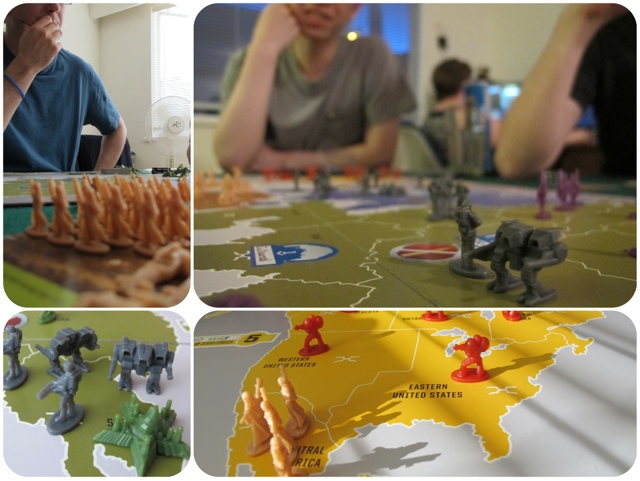
Recently, however, I got my hands on a copy of Risk: Legacy, the newest version of the game, and one with dramatic changes to the core gameplay. I'd heard about this game around it's release in 2011 and it sounded too much fun to ignore at the least the hype around it. So I grabbed a few similarly minded friends and cracked it open.

As well as standard Elimination, Legacy brings in the concept of victory points, speeding up the gameplay significantly. Victory is awarded as soon as one player achieves four Red Stars. HQs count as one, so everyone starts with a point, and you can buy more with cards. If you've never won a game on this board before, then you start the game with an extra Red Star! If you have won, then you get a missile for every victory you've managed instead.

But how do you keep track of who has or hasn't won a game? Or how often one player has won over another? That's where Legacy becomes, as far as I know, utterly unique, and, as far as I'm concerned, absolutely fascinating.

In Risk: Legacy, players Mark the board in a number of ways. Before your first game, you sign the back of the board, building up a list of signatories of those who fought over this Alter-Earth. Each game you play you sign the back of the Faction board you're controlling this game, marking if you Won, Held-On, or were Eliminated at the end of the game. When you win, you sign in an area on the left of the global map. All these make it clear how players start during the subsequent games. Do you get a bonus Red Star, or a missile? Check the list of winners and count how often your name appears. How is your chosen Faction doing compared to others? How is its Win/Loss ratio? Has it ever been eliminated? Check the back of the Faction boards.

But it's not all just penmanship and neat handwriting. Win or lose, you get to Mark the board in a variety of exciting ways. Players get to place stickers on the game board, permanently altering the board for all future battles! You can found and name Minor or Major Cities, alter the value of a territory, strengthen a location or even name an entire continent! Earth 23190 (every copy of the game has a unique serial number, your own Earth designation! Amazing!) now has the Major City of New Raynia, as well as the continent of Heaven's Rayn (formerly Europe). We can battle over the cities of Porkchop in China, Outsourced in India (genius-level naming from a friend!), or Pomidor in Russia, among many others. In my experiences, this founding and naming phase often takes longer than the game itself, which is testament to how much fun this is, how much thought players want to put into these permanent changes, and how fast the game play is!

So you can Mark the board before and after the war has been fought, but also during! Scar tokens are stickers you can play from your hand to affect territories. But be warned, they stay Scarred for all future games as well. Nothing it transient. Everything you do has dramatic, lasting effects. What helps you now could destroy you in a future game. Put an ammo shortage on Greenland, and suddenly it's easy to sweep into North America from Europe, breaking a powerful continent bonus at a critical moment.

And once you've expended a card on a Scar, you rip it up! Tearing up board game elements is a thrilling experience, and I recommend anyone that has been frustrated by an over-powered card in any game to give it a go. Better yet, it never stops being a rush. Weather it's the first game or the seventh, ripping up a card from Risk: Legacy, permanently destroying an element from the game box, raises my heart-rate by a few beats and brings a huge smile to my face. I personally like to image those cards as the Skeletons from Small World, the Curator from Elder Sign, or the [REDACTED] from Risk: Legacy itself! Frakk you, you nine unit killing [REDACTED]! I so enjoyed tearing you up.

But ripping up cards means you run out of them at some point, right? Sort of. As you play, you get to open new packets of cards under certain conditions. The first time a Faction is Eliminated, the first time one players signs the board a second time, the first time three missiles are used in a single combat. All these and more allow you to open sealed envelopes of new cards. These cards progress the war, altering rules in the rulebook, or elements of the board. They add new cards to the decks, or entirely new decks of cards! I'm not going to spoil anything that is inside these envelopes. Opening one truly is a wonderful moment, and the anticipation brought on by not knowing what is about to happen is something I can never experience again, but you should.

All that is well and good, but how does Risk: Legacy play? Well, it mostly plays like Risk. You build up troops each turn, move out and conquer territories, and try to gain enough of a foothold to unexpectedly snatch victory, without becoming too powerful too quickly and becoming a unifying threat to your opponents. One huge change is that "turtling" really doesn't work. In classic Risk, a valid and powerful strategy is to hold an area, with a large number of troops in border territories, building up a dominating force to wash out and cause chaos. Legacy moves much to fast to allow that. There simply isn't enough turns in the game. Plus, it rewards even the smallest skirmish with territory cards awarded to a victorious attacking army, which can be used to purchase more troops or Red Stars. So pressing the attack on your turn is always in your interest, keeping the game moving at an astonishing clip. Some of our games have literally lasted as little as three turns per player!

Risk: Legacy is a fun, exciting, pulse-pounding experience, both during the hard fought wars, and in the cold aftermath. If you've always avoided Risk, do yourself a favour and try this game. I've loved every one of the seven battles I've fought to date, even when I lost. There is always something fun to do, weather you win, lose or get eliminated.

The components in the box allow for 15 games where the world can be Marked or Scarred, at the end of which an ultimate victor is declared and the ravaged planet is set. How often have you played any board game 15 times? For me, I could probably only say Battlestar Galactica has reached that number. With that in mind, even altering the game forever, even having a point in the future where we won't have anything more to place, removing the most fun aspect of this version, Risk: Legacy is worth every penny.

In the two years since its release, no-one else has copied Legacy's style, and it's easy to see why. In a world where errata's and FAQ's are common place, there is no room for error in a game like this. If an unexpected sticker combination breaks the game, it's difficult to easily fix that after release. I can only imagine Legacy was playtested to death and back again to make certain that nothing slipped through, and that level of testing and refinement is not possible for every game. Thankfully, it paid off here.

One last point, which has nothing to do with gameplay. The production quality for this game is astounding! The whole game is presented in a beautiful box that resembles a briefcase, with sticker packets secured to the inside lid, reminding me of those war cases from Mission: Impossible or some Cold War era spy thriller. Everything from the unique tokens for each Faction, to the beautiful and vibrant global map, to the gasp-inducing [REDACTED] in the [REDACTED]* envelope is made with a high standard of quality, but what impressed me most, I think, was the stitch binding on the rulebook! It's just a neat little touch that cleanly illustrates the love and respect that Hasbro have towards this game, and the confidence that it was going to be a big hit.

*- Now I'm just teasing!

Related Posts
Board Game Review Hub
King of Tokyo
Pandemic
Shadow Hunters
Forbidden Island
Elder Sign
Red November
Escape The Curse of the Tomb
Race to Adventure

Board Game Review Master List

Since moving to Vancouver, I've had the chance to play and experience a huge range of new boardgames thanks to new friends with new interests, not to mention an surge of new releases in that time. I've occasionally tweeted my enjoyment or disappointment over a game, but I thought I'd expand on those 140 characters here, and break down my favourite board/card games.

Some of these are new games, some are old games that have just been introduced to me, and a few are reprints, or new editions. There are a number of ways I could approach this list, but after giving it some thought, we will start with Risk: Legacy, then King of Tokyo, and so on in that fashion.

Risk: Legacy
King of Tokyo
Forbidden Island
Elder Sign
Red November
Escape The Curse of the Temple
Race to Adventure
Pandemic

Shadow Hunters

Hanabi
Love Letter & Lost Legacy
Cosmic Encounter
Legendary Encounters
Dixit
Sheriff Of Nottingham
2-Player Mini Reviews
Codenames
Quantum
XCOM The Board Game
Inis
Captain Sonar

I update this list with new links as I write more board game reviews, such that this post is a hub for all my reviews. Bookmark it for easy access any time you need it.

Bonus Related Posts:

The Game Canopy
ChromaCast Cajon Bag
Battle of the Board Game Bags, a comparison of the Canopy and the ChromaCast


Thursday, June 20, 2013

Sally Slick: Centurion Of The Century

Way back in 2012, while we were between visas and unemployable, Evil Hat lived up to the "Evil" part of their title and started a KickStarter that I had no hope of resisting. Their goal was to release a trilogy of novels based in the Spirit of the Century universe, following the adventures of the Century Club, a team of heroes that have been, quite literally, born to protect the 20th century. The books were to be true pulp action, inspired by the pulp novels of the early 1900's.

I threw in my money, and watched in joyous horror as the number in the corner went up and up, far beyond anyone's expectations! More and more novels, from more and more incredible authors were added to the line-up, and the final tally leveled out at seven books! For the princely sum of $10 that I could scrape together at the time, I got everything in digital format!

Later, after I was blissfully back at work, Evil Hat tried their hands at another crowd funded project. This time, they sought to update their Fate System, the engine upon which Spirit of the Century and later Dreden Files, was built. They chose to call the new system Fate Core, and the KickStarter was set at a lowly $3,000 asking price.

Which it managed in minutes.

I was lucky enough to get in early enough to nab one of the elusive limited Pledge Levels. As the Stretch Goals piled up, so too did my pledge, slowly rising as I sought to get more and more physical content.

And then, late in the run, Evil Hat announced a new novel as part of the Fate Core campaign!

Sally Slick and the Steel Syndicate was to be a young adult novel based before the events of the Spirit of the Century role-playing games and the previously funded novels, set around 1914, when Sally is just discovering the wider world, and the world is just about to discover her!

I was delighted! Not only was I in love with the idea of more material from the universe, but I had recently discovered the Young Adult genre of novels, and found them a wonderful, refreshing change of pace from the heavy, all-too-often dark and depressing, plain old adult novels I usually read.

I've been reading all the Spirit of the Century books as they've been released to the KickStarter Backers, and enjoying them all. Each one is crafted with love of the characters and the era. Each is packed with thrilling adventures and daring escapes. Each is a joy to read, and as soon as I finish one, I can't wait to read the next.

With that in mind, having been following the development of this whole thing from the start, it gives me great pleasure to be a part of this official world reveal!

Ladies and gentlemen, boys and girls, I give you the wonderful art of Dani Kaulaki that will adorn the cover of Carrie Harris's Sally Slick and the Steel Syndicate! Take it home, Dani!

[Click to View in Full Glory]

Title: SALLY SLICK AND THE STEEL SYNDICATE
Release date: December 3, 2013
Publisher: Evil Hat Productions
Ages: 12 and up

Jacket description:
Every hero has a story. This one starts with a girl and a racing tractor.

Sally Slick knows she’s meant to be more than a Midwestern farm girl. What she wants more than anything is to be an inventor when she grows up—and she has the custom-built racing tractor to prove it. But good girls in 1914 don’t go off to the city in search of adventure. Everything changes when Sally’s big brother comes back from Chicago with a robot in hand and mobsters on his heels. With the help of her friend, wannabe hero Jet Black, Sally will risk everything to protect the people she loves.

Those bad guys are about to get a giant wrench thrown right into their plans.

Saturday, March 30, 2013

International TableTop Day: Prologue

As it is officially past midnight here on the Pacific coast, the first International TableTop Day has begun!

We have loads planned for it in our place, with about a dozen friends expected to call in over the course of the day and play a huge variety of games, from Forbidden Island and Pandemic, to Elder Sign and Small World. We might even get in a fast-form RPG, like Fiasco if there's interest.

We've gotten hold of a few extra chairs and an extra coffee table to allow for multiple games running at once, as hopefully there will be enough people around at some parts of the day to make that a real possibility!

I've also managed to install a custom firmware on an SD card that will give my Canon G12 a bunch of cool extra features, the most important of which, for tomorrow is time lapse! I'm hoping to photograph a few games with this and upload them later to my YouTube page! Naturally, I'll be taking a bunch of photos as well, and they'll be found on my Flickr.

I'm really looking forward to being a part fo this, especially for it's first year running! If we do get a dozen folks showing up, we'll have more people than some of the local gaming stores are expecting!

We're starting at noon today as I post this, Saturday, March 30th, and we intend to end when the second-to-last person can physically got play another game! Pizza has been promised for dinner, and snacks will be available throughout the day!

So, what are you doing for TableTop Day? Even if it's just getting together with friends for an hour or two in the evening, make and effort to play something with friendly company!

And remember, is TableTop Day, so boardgames, card games, role-playing games, anything counts! Just game and have fun!

Tuesday, February 19, 2013

The Best Of Both Worlds

I recently restarted my Netflix subscription, giving me access to a huge library of content on my Xbox 360, and now, also, my iPad. The last time I had access to the instant streaming service, I watched the entire six seasons of News Radio within three weeks. Admittedly, I was off work at the time and had little else to do. It would appear that, since then, Netflix has become a treasure trove of my childhood, playing host to classics such as Knight Rider, Sliders, The A-Team, and Quantum Leap. I immediately ran into the same problem that so many others have had on starting a Netflix subscription. With so much to watch, where should one begin?

After some consideration, I decided to begin at the start.

Star Trek was my first experience with science-fiction. I watched the movies with my dad, over and over as they were aired on terrestrial television. I soaked them in, losing myself on board the Enterprise. So when Star Trek: The Next Generation began, I relished it. I watched every episode, made easier as they were aired in a prime time slot on the Irish station. I have many happy memories, and one particularly vivid nightmarish one.

So when I started watching TNG on Netflix on Saturday, I feared that my happy nostalgia would be ruined by the cold reality of film.

But it wasn't. I was back on the bridge of the USS Enterprise, under the command of Captain Picard and his excellant crew. The effects were low-tech by todays standards, but just as I remembered them, and the ship was fibreglass and fibre optics, a physical prop rich in detail and design. Tasha Yar was still alive, and all was right with the world.

Almost.

Star Trek, like any series, was not without it's dud episodes, and with seven seasons containing 178 episodes, there were quiet a few duds in The Next Generations catalogue, epecially in the first two seasons, while it was still trying to find it's feet. So how do you keep the wonder of childhood alive in the face of 25 years of life?

Thankfully, this isn't the primitive 20th Century any more! We are of the Internet age!

I turned to TV.com. Thanks to its ratings system, I could pick and choose the episodes I wanted to see. For the ones that fell below my assigned cut-off point, I could read the plot synopsis and decide if I remembered it, or felt like it deserved a chance. In this way, I watched Season 1 as I remembered, if not entirely as it was. It was dramatic and exciting, funny and action packed, and entirely entertaining. Every episode was fantastic, and, exactly as my memory assured me, there were no let-downs. Once more, I saw Tasha die, and got to watch in amazement as the brain-worm-host-queen-thing gets phasered by Picard and Riker until his head explodes and his body is set alight. It was exactly how I remember the scene from the first time I saw it, one of the lasting images I always retained of The Next Generation.

We're in to Season 2 now. Riker has his beard, Wesley is at the helm, Geordie is in Engineering, an Irishman is at the transporter console, and according to TV.com, there's a lot more to skip this season. Thankfully, I still have a lot to look forward to, as the ones that hold up get higher average scores than Season 1's best. At least we get to Season 3 faster, when the show really hit it's stride.

So I only rewatch the best. Many episodes are those that, as I watch them now, I realize I still remember the plots to, the ones that stayed with me, and possibly influenced me in becoming the man I am today. Star Trek: The Next Generation showed me a future where anything was possible, and "no being is so important that he can usurp the rights of another" [Captain Picard, S02E06].

It may be a cheat, but it's the best kind of cheat.