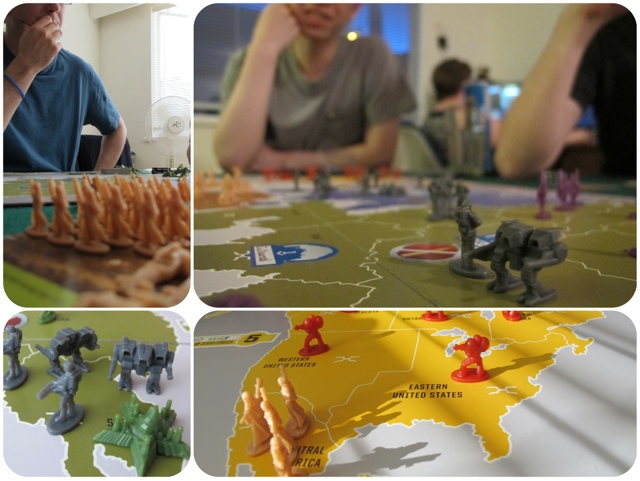
I've never played a game of classic
Risk. One of the factors that kept me away from the classic version is the length of gameplay.
Risk was about playing until there was a single army standing, and games could go for hours as people battled over land, formed and broke favourable pacts, and slowly whittled each other down. It rewarded strategy, cunning and experience, none of which I possessed in great amount. If you got knocked out early, you usually had time for another game of something else while you were waiting for
Risk to end, so I just skipped the pain and didn't start playing in the first place.
Recently, however, I got my hands on a copy of
Risk: Legacy, the newest version of the game, and one with dramatic changes to the core gameplay. I'd heard about this game around it's release in
2011 and it sounded too much fun to ignore at the least the hype around it. So I grabbed a few similarly minded friends and cracked it open.

As well as standard
Elimination,
Legacy brings in the concept of victory points, speeding up the gameplay significantly. Victory is awarded as soon as one player achieves four
Red Stars.
HQs count as one, so everyone starts with a point, and you can buy more with cards. If you've never won a game on this board before, then you start the game with an extra
Red Star! If you have won, then you get a missile for every victory you've managed instead.
But how do you keep track of who has or hasn't won a game? Or how often one player has won over another? That's where
Legacy becomes, as far as I know, utterly unique, and, as far as I'm concerned,
absolutely fascinating.
In
Risk: Legacy, players
Mark the board in a number of ways. Before your first game, you sign the back of the board, building up a list of signatories of those who fought over this
Alter-Earth. Each game you play you sign the back of the
Faction board you're controlling this game, marking if you
Won, Held-On, or were
Eliminated at the end of the game. When you win, you sign in an area on the left of the global map. All these make it clear how players start during the subsequent games. Do you get a bonus
Red Star, or a missile? Check the list of winners and count how often your name appears. How is your chosen
Faction doing compared to others? How is its
Win/Loss ratio? Has it ever been eliminated? Check the back of the
Faction boards.

But it's not all just penmanship and neat handwriting. Win or lose, you get to
Mark the board in a variety of exciting ways. Players get to place stickers on the game board, permanently altering the board for all future battles! You can found and name
Minor or
Major Cities, alter the value of a territory, strengthen a location or even name an entire continent!
Earth 23190 (
every copy of the game has a unique serial number, your own Earth designation! Amazing!) now has the
Major City of
New Raynia, as well as the continent of Heaven's
Rayn (
formerly Europe). We can battle over the cities of
Porkchop in China,
Outsourced in India (
genius-level naming from a friend!), or
Pomidor in Russia, among many others. In my experiences, this founding and naming phase often takes longer than the game itself, which is testament to how much fun this is, how much thought players want to put into these permanent changes, and how fast the game play is!
So you can
Mark the board before and after the war has been fought, but also during!
Scar tokens are stickers you can play from your hand to affect territories. But be warned, they stay
Scarred for all future games as well. Nothing it transient. Everything you do has dramatic, lasting effects. What helps you now could destroy you in a future game. Put an ammo shortage on
Greenland, and suddenly it's easy to sweep into North America from Europe, breaking a powerful continent bonus at a critical moment.
And once you've expended a card on a
Scar, you
rip it up! Tearing up board game elements is a thrilling experience, and I recommend anyone that has been frustrated by an over-powered card in any game to give it a go. Better yet, it never stops being a rush. Weather it's the first game or the seventh, ripping up a card from
Risk: Legacy, permanently destroying an element from the game box, raises my heart-rate by a few beats and brings a huge smile to my face. I personally like to image those cards as the
Skeletons from
Small World, the
Curator from
Elder Sign, or the
[REDACTED] from
Risk: Legacy itself!
Frakk you, you nine unit killing
[REDACTED]! I so enjoyed tearing you up.

But ripping up cards means you run out of them at some point, right? Sort of. As you play, you get to open new packets of cards under certain conditions. The first time a
Faction is
Eliminated, the first time one players signs the board a second time, the first time three missiles are used in a single combat. All these and more allow you to open sealed envelopes of new cards. These cards progress the war, altering rules in the rulebook, or elements of the board. They add new cards to the decks, or entirely new decks of cards! I'm not going to spoil anything that is inside these envelopes. Opening one truly is a wonderful moment, and the anticipation brought on by not knowing what is about to happen is something I can never experience again, but you should.
All that is well and good, but how does
Risk: Legacy play? Well, it mostly plays like
Risk. You build up troops each turn, move out and conquer territories, and try to gain enough of a foothold to unexpectedly snatch victory, without becoming too powerful too quickly and becoming a unifying threat to your opponents. One huge change is that "
turtling" really doesn't work. In classic
Risk, a valid and powerful strategy is to hold an area, with a large number of troops in border territories, building up a dominating force to wash out and cause chaos.
Legacy moves much to fast to allow that. There simply isn't enough turns in the game. Plus, it rewards even the smallest skirmish with territory cards awarded to a victorious attacking army, which can be used to purchase more troops or
Red Stars. So pressing the attack on your turn is always in your interest, keeping the game moving at an astonishing clip. Some of our games have literally lasted as little as three turns per player!
Risk: Legacy is a fun, exciting, pulse-pounding experience, both during the hard fought wars, and in the cold aftermath. If you've always avoided
Risk, do yourself a favour and try this game. I've loved every one of the seven battles I've fought to date, even when I lost. There is always something fun to do, weather you win, lose or get eliminated.

The components in the box allow for
15 games where the world can be
Marked or
Scarred, at the end of which an ultimate victor is declared and the ravaged planet is set. How often have you played any board game
15 times? For me, I could probably only say
Battlestar Galactica has reached that number. With that in mind, even altering the game forever, even having a point in the future where we won't have anything more to place, removing the most fun aspect of this version,
Risk: Legacy is worth every penny.
In the two years since its release, no-one else has copied
Legacy's style, and it's easy to see why. In a world where errata's and FAQ's are common place, there is no room for error in a game like this. If an unexpected sticker combination breaks the game, it's difficult to easily fix that after release. I can only imagine
Legacy was playtested to death and back again to make certain that nothing slipped through, and that level of testing and refinement is not possible for every game. Thankfully, it paid off here.
One last point, which has nothing to do with gameplay. The production quality for this game is astounding! The whole game is presented in a beautiful box that resembles a briefcase, with sticker packets secured to the inside lid, reminding me of those war cases from
Mission: Impossible or some
Cold War era spy thriller. Everything from the unique tokens for each
Faction, to the beautiful and vibrant global map, to the gasp-inducing
[REDACTED] in the
[REDACTED]* envelope is made with a high standard of quality, but what impressed me most, I think, was the stitch binding on the rulebook! It's just a neat little touch that cleanly illustrates the love and respect that
Hasbro have towards this game, and the confidence that it was going to be a big hit.
*- Now I'm just teasing!
Related Posts
Board Game Review Hub
King of Tokyo
Pandemic
Shadow Hunters
Forbidden Island
Elder Sign
Red November
Escape The Curse of the Tomb
Race to Adventure
 Each turn consists of players choosing from a number of items, such as the Jetpack, Biplane or Raygun, starting with the current First Player and proceeding clockwise. Once everyone has chosen, all players do their actions together, simultaneously. Then the First Player token moves clockwise to the next player and the next turn begins.
  The board is made up of tiles that are laid out in a 3x3 grid, beside the heroes base of operations in the Empire State Building that makes up the leftmost column. In a move that is nothing short of genius, each tile has a standard side and a Shadow side. This ties nicely into the setting, where the heroes are Centurions, while the villains of the universe are referred to as Shadows. The Shadow sides offer a higher level of difficulty through greater mission requirements and more impassible borders, requiring more thought on strategy for the current and upcoming turns.